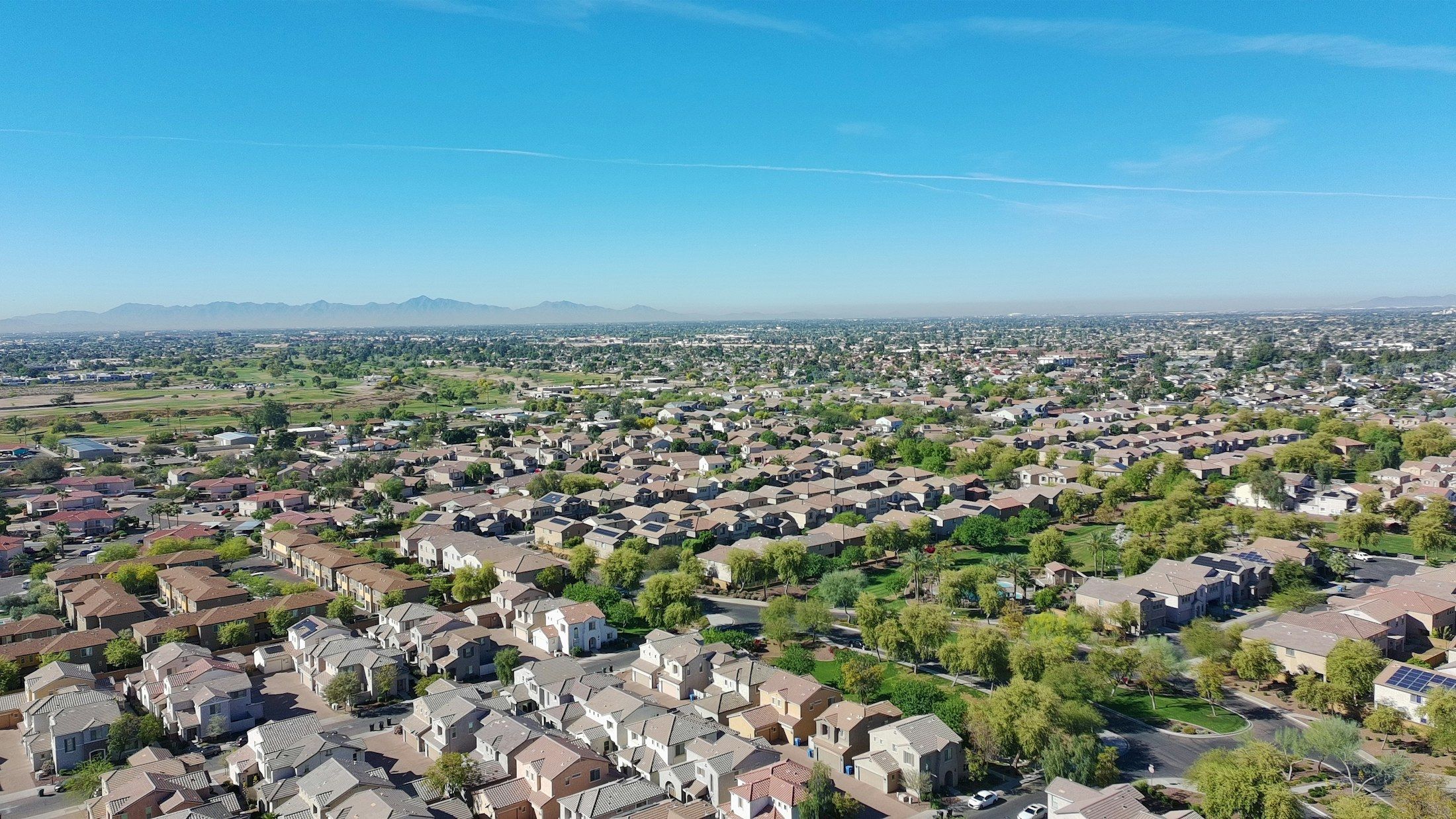
From the 1980s in the south to the 2010s up north
Peoria went from about 12,000 residents in 1980 to more than 108,000 in 2000. U.S. Census Bureau survey data (American Community Survey, 2020–2024) puts the median Peoria home at 1999. About a quarter of homes date from the 1990s and another quarter from the 2000s. Fewer than 10% predate 1980, and about three in four homes are owner-occupied.
The age of your house depends a lot on where it is:
- South Peoria. In ZIP code 85345, the city’s southernmost, the median home dates to 1988 and about a quarter were built before 1980. About 11% are manufactured homes.
- Central Peoria. In 85381 and 85382, the medians are 1995 and 1997.
- Far north Peoria. In 85383, the median home dates to 2010, and nearly nine in ten were built in 2000 or later.
ZIP codes cross city lines, so use these as a rough guide.
Which side of Bell Road you’re on
Peoria’s water comes from different places depending on your address. A city water FAQ (undated, archived in January 2024) breaks it down:
- North of Bell Road, water comes from groundwater wells and the Pyramid Peak Water Treatment Plant, which treats Colorado River water from the CAP canal. Pyramid Peak water averages about 17 grains per gallon of hardness.
- South of Bell Road, water comes mainly from wells and the Greenway Water Treatment Plant, which treats Salt and Verde river water from the Arizona Canal. Greenway water averages about 13 grains.
- Well water ranges from 2 to 8 grains. The FAQ says the share of well water rises in summer and near active wells.
So hardness at your tap can change over the year, and the city links an interactive hardness map for checking your address. Harder water leaves more scale in water heaters and fixtures, and ENERGY STAR lists rumbling from sediment, rust in the water and leaks at seams as signs a tank is near the end. See water heater and appliance leaks.
SRP flood irrigation near the washes
Peoria’s water FAQ says flood irrigation “still exists in certain places.” SRP lands in Peoria are south and east of the Skunk Creek and New River washes, and some parks and some single-family homes there still take SRP irrigation water.
If your yard is flood-irrigated, the berms are what keep that water off the slab. After each delivery, look for water sitting against the foundation, the garage or a patio door. If flooding looks unintentional, the city asks residents to call its water leak line. If water gets inside, stay clear of wet outlets, take photos and get it out quickly. See emergency water extraction.
Your sewer line, up to the main
When sewage backs up, where the blockage is decides who fixes it. If the problem is in the city’s main, the city repairs it, and property damage claims go to its Risk Management Division. The sewer lateral, the pipe from your house to the main, “is owned and maintained by the property owner.” A blockage there is yours to fix, usually with a plumber.
Sewage in the house is Category 3 water under the IICRC’s restoration standard, which describes it as grossly contaminated. The EPA advises calling in a professional with experience cleaning buildings damaged by contaminated water, and says not to use fans until you know the water is clean. Keep children and pets away. See sewage backup cleanup. Many homeowners policies need a separate endorsement to cover sewer backups, so check yours, and see the insurance guide.
When Skunk Creek runs
Skunk Creek and the New River cross Peoria, and they can run hard after heavy rain upstream. On August 19, 2014, storms north of the metro sent water down nearly every wash in the area. The National Weather Service photographed flooding along Skunk Creek in Peoria, and the creek peaked at 12,927 cubic feet per second at I-17. The Weather Service also documented hail estimated at 1 to 1.5 inches in Peoria on September 26, 2025.
The Flood Control District of Maricopa County says every property in the county has some flood risk, even outside mapped floodplains, and that most homeowners policies don’t cover flood damage. For roof leaks and storm water, see monsoon and storm water damage.
Steps for a Peoria home
- Stop the water at the fixture or the main valve. If drains are backing up, stop running water in the house.
- Keep people and pets out of sewage, and wear rubber gloves and boots if you must go in.
- Take photos before you move or throw away anything.
- Call to reach an independent restoration provider that serves Peoria, and a plumber for broken pipes or a blocked lateral.
The first-hour guide walks through each step.