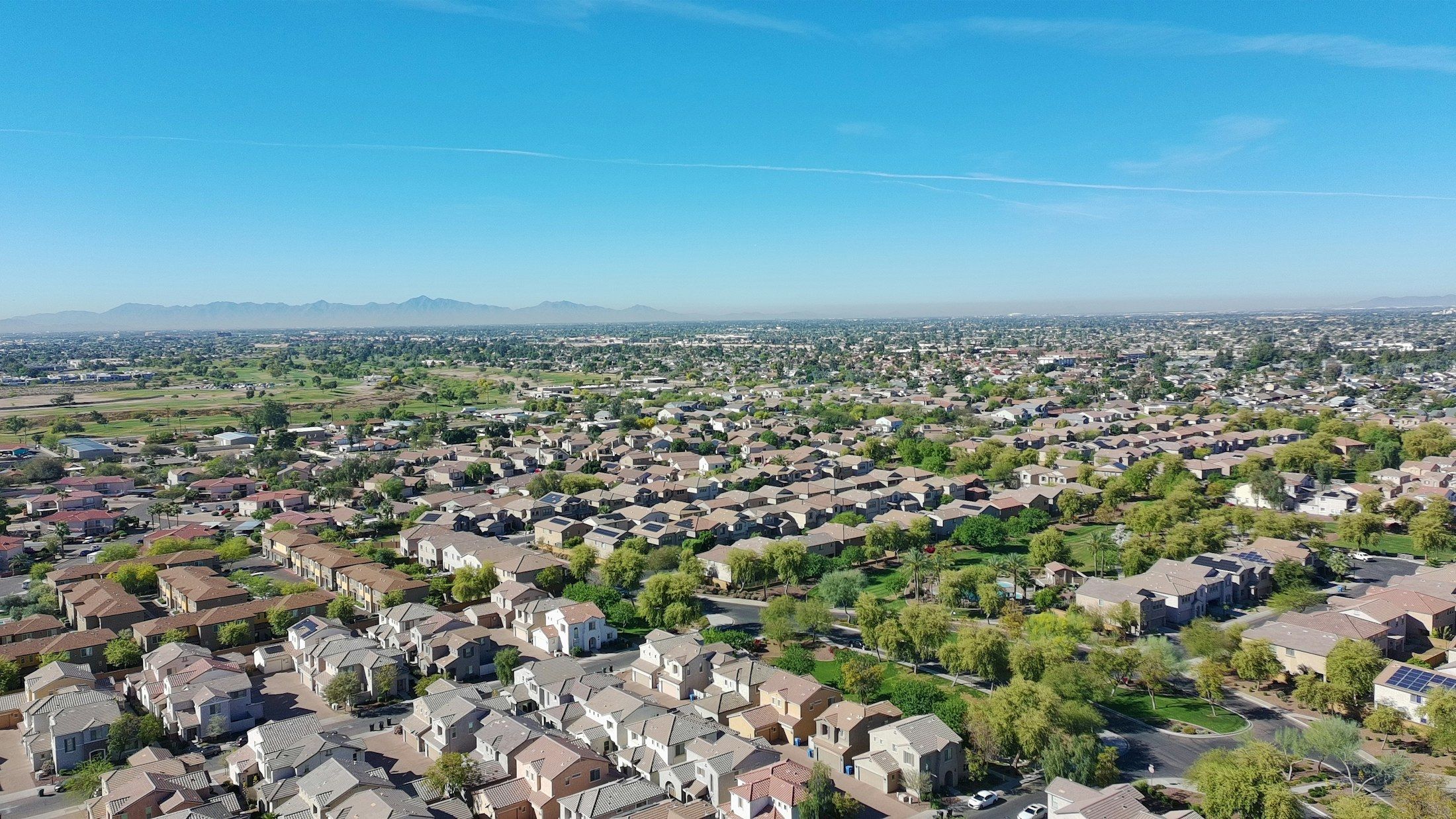
Two very different parts of town
Scottsdale incorporated in 1951 on about half a square mile and now covers roughly 184. U.S. Census Bureau survey data (American Community Survey, 2020–2024) puts the median Scottsdale home at 1991, but that single number hides a wide spread:
- South Scottsdale. The city’s Southern Scottsdale Character Area Plan describes mostly single-family ranch homes in some of the oldest neighborhoods in the city, developed from the late 1950s through the early 1980s. In ZIP code 85257 the median home dates to 1971, and 68% predate 1980. ZIP codes 85250 and 85251 have medians of 1976 and 1979.
- North Scottsdale. ZIP code 85262 has a median of 2005, with 73% of homes built in 2000 or later. ZIP codes 85255 and 85266 sit around 1999 to 2000.
In a south Scottsdale ranch house, valves, drain lines and fixtures may be decades old. In a newer home up north, the plumbing is younger, but water heaters, supply lines and AC drains wear out on their own schedule.
Scottsdale’s hard water and your water heater
Scottsdale’s 2026 water quality report (2025 data) gives approximate hardness of 13 to 15 grains per gallon south of Indian School Road and 13 to 17 north of it. Older city materials list higher numbers, so go by the latest report.
The City of Scottsdale’s guide to water heaters has advice that fits these conditions:
- Expect about 12 years. The city cites industry figures putting the average water heater’s life at 12 years.
- Drain sediment. In areas with high mineral content, drain at least 5 gallons every six months. The city names overheating from sediment buildup as a main cause of failure.
- Check the anode. Replacing the anode rod every 3 to 4 years adds considerable life, and softened water wears it out faster.
- Look once a month. The city suggests a monthly visual check, since a tank that rusts through can only be replaced.
See water heater and appliance leaks for the cleanup side.
Checking the meter and finding the valve
The City of Scottsdale describes a 30-minute leak test:
- Turn off all water use inside and outside the house.
- Write down the meter reading and where the sweep hand sits.
- Use no water for at least 30 minutes, then check again.
- If the reading changed or the sweep hand or triangle moved, something on the property is pulling water through the meter, and you most likely have a leak.
The city also says to know where your cut-off valve is. In Scottsdale, it’s located next to the water meter box. That’s different from Phoenix and Chandler, where the cities say the valve is usually near an outside faucet at the front of the house. The shut-off valve guide has more on finding and closing it.
A leak you can’t see may be under the floor. See slab leak water damage.
The Indian Bend Wash greenbelt
For decades, heavy rain on the Indian Bend Wash stranded drivers and caused property damage. After Scottsdale voters approved a bond issue in 1973, the city built the Indian Bend Wash Greenbelt, an 11-mile chain of parks, lakes, paths and golf courses that carries floodwater through the middle of the city. It was first planned as a concrete-lined channel, and it was finished in 1985.
The greenbelt still fills during big storms. On September 26, 2025, the National Weather Service reported the wash above flood stage near Indian School Road. Vehicles were trapped and submerged, and one person died. The Flood Control District of Maricopa County warns that six inches of water can knock you off your feet.
North Scottsdale floods too. The NWS documented street flooding along Hualapai Drive on September 16, 2026. Scottsdale also averages more rain than central Phoenix: 8.73 inches a year, compared with 7.22 at Sky Harbor, based on NWS normals for 1991 to 2020.
Drainage on your own lot
The city says drainage facilities are generally the homeowner’s or HOA’s to maintain, even inside a drainage easement dedicated to the city. In the Environmentally Sensitive Lands area that covers the northern desert, the 100-year floodplains of larger washes must stay natural, and blocking or narrowing a watercourse is prohibited.
If you’re looking into flood insurance, the city says it should have an elevation certificate on file for homes built after 1990, while one probably doesn’t exist for homes built before 1989. For storm-related damage inside the house, see monsoon and storm water damage.
First steps in a Scottsdale home
- Close the cut-off valve by the meter box, or the valve on the leaking fixture.
- Stay away from water near outlets or the electrical panel.
- Photograph the damage before anything is moved or thrown out.
- Call to reach an independent restoration provider that serves Scottsdale.