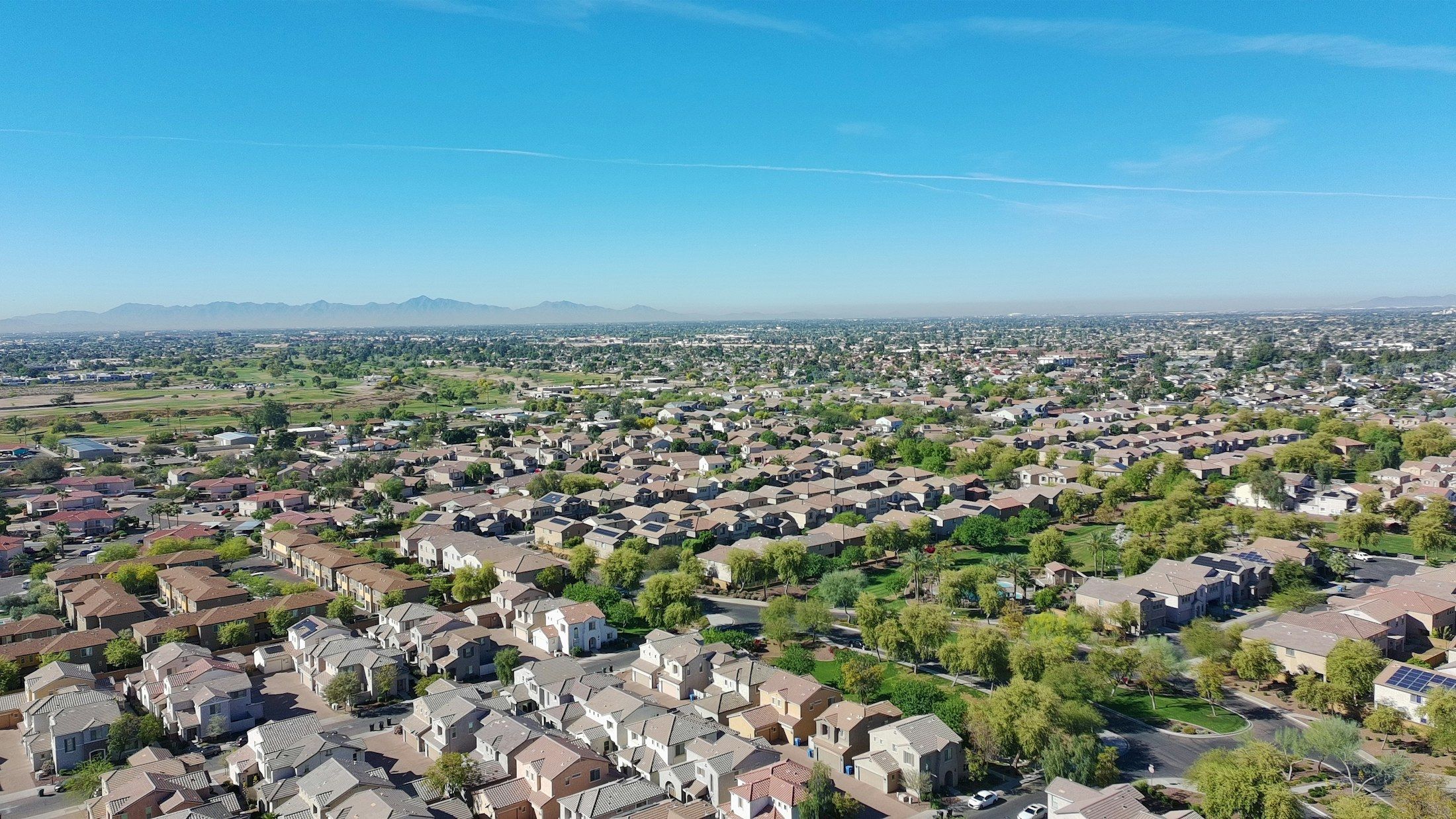
A young town on old farm ground
Queen Creek began as farm country. The town says settlers came in the early 1900s to farm cotton, corn and potatoes, and homesteaders ranched along Queen Creek Wash. Most of today’s houses came much later. U.S. Census Bureau survey data (American Community Survey, 2020–2024) puts the median Queen Creek home at 2012. About 40% were built in the 2010s, and about 91% in 2000 or later, compared with about 37% statewide. Only about 3% predate 1980.
A newer house still has parts that wear out. ENERGY STAR puts the typical life of a tank water heater at about 13 years, so an early-2010s home on its original tank is at or past that point. Washing machine hoses, refrigerator lines and the braided supply lines under sinks fail on their own schedule too.
Sewer in some neighborhoods, septic in others
Queen Creek’s sewer doesn’t reach every home. The town says its sewer utility serves “the Town Center and much of the planned higher density residential areas.” Other homes rely on septic systems. The town publishes septic care guidance for them, though it doesn’t say how many there are. It notes that homeowners are usually the ones responsible for maintaining their system, and that maintenance records must be kept and passed on to later owners.
Which one you have changes what a backup means:
- On septic. The tank and drain field are yours. A backup into the house points to your own system, and a septic service or plumber handles that part.
- On sewer. A plumber can find where the blockage is and whether it’s in your line.
Either way, sewage in the house is Category 3 water under the IICRC restoration standard, meaning it’s grossly contaminated. The EPA advises calling in a professional with experience cleaning up contaminated water. See sewage backup cleanup.
Flood-irrigated yards
The town delivers irrigation water to about 500 homes year-round, using Central Arizona Project water brought in by the Queen Creek Irrigation District. Its irrigation page is plain about who’s responsible: “Property owners are responsible for keeping the water contained in their yards.”
Before each delivery, check the berms and fill gopher holes. If irrigation water does reach the house, it can seep under doors and soak the bottom of walls and baseboards. See emergency water extraction.
The Queen Creek and Sonoqui washes
The town’s General Plan describes two washes that “run diagonally through Queen Creek.” The Flood Control District of Maricopa County says that historically, Queen Creek and Sonoqui Wash “lacked sufficient capacity to contain 100-year storm events.” A master plan to address that was finished in 2000, and projects have been built in phases since.
Sonoqui Wash starts as two branches in Pinal County and flows northwest across Queen Creek into Gilbert. On July 10 and 11, 2008, a heavy storm sent it over the Sossaman and Power road crossings and eroded them, the East Valley Tribune reported.
Wind matters too. The National Weather Service recorded a 73 mph gust in Queen Creek on August 16, 2021, and a damaged roof can let rain in during the next storm.
The town lies in both Maricopa and Pinal counties and has a separate floodplain ordinance for each, so ask the town whether your lot is in a mapped floodplain. For storm water and roof leaks, see monsoon and storm water damage.
Hard water from town wells
The town’s drinking water comes from groundwater wells. Its FAQ puts hardness at 6 to 17 grains per gallon. The 2024 water quality report lists an average of 206 parts per million, roughly 12 grains per gallon.
Hard water leaves scale in pipes, fixtures and water heaters. A report prepared for the U.S. Department of Energy recommends draining storage tanks every year in hard-water areas to remove sediment. See water heater and appliance leaks.
The town’s meter test
The Town of Queen Creek describes a simple leak check: turn off all water, read the meter, wait about an hour and read it again. “If your second reading is higher than the first, you have a leak.” If nothing obvious explains it, the leak may be under the slab. See slab leak water damage. After a significant leak, the town says winter-average sewer fees can be adjusted, so ask once the repair is done.
Right after you find water
- Close the valve on the leaking fixture, or the main shut-off. The shut-off valve guide shows what to look for.
- If sewage is involved, keep children and pets away and don’t run fans.
- Take photos and video before you move anything.
- Call to reach an independent restoration provider that serves Queen Creek, plus a plumber or septic service if the source needs repair.