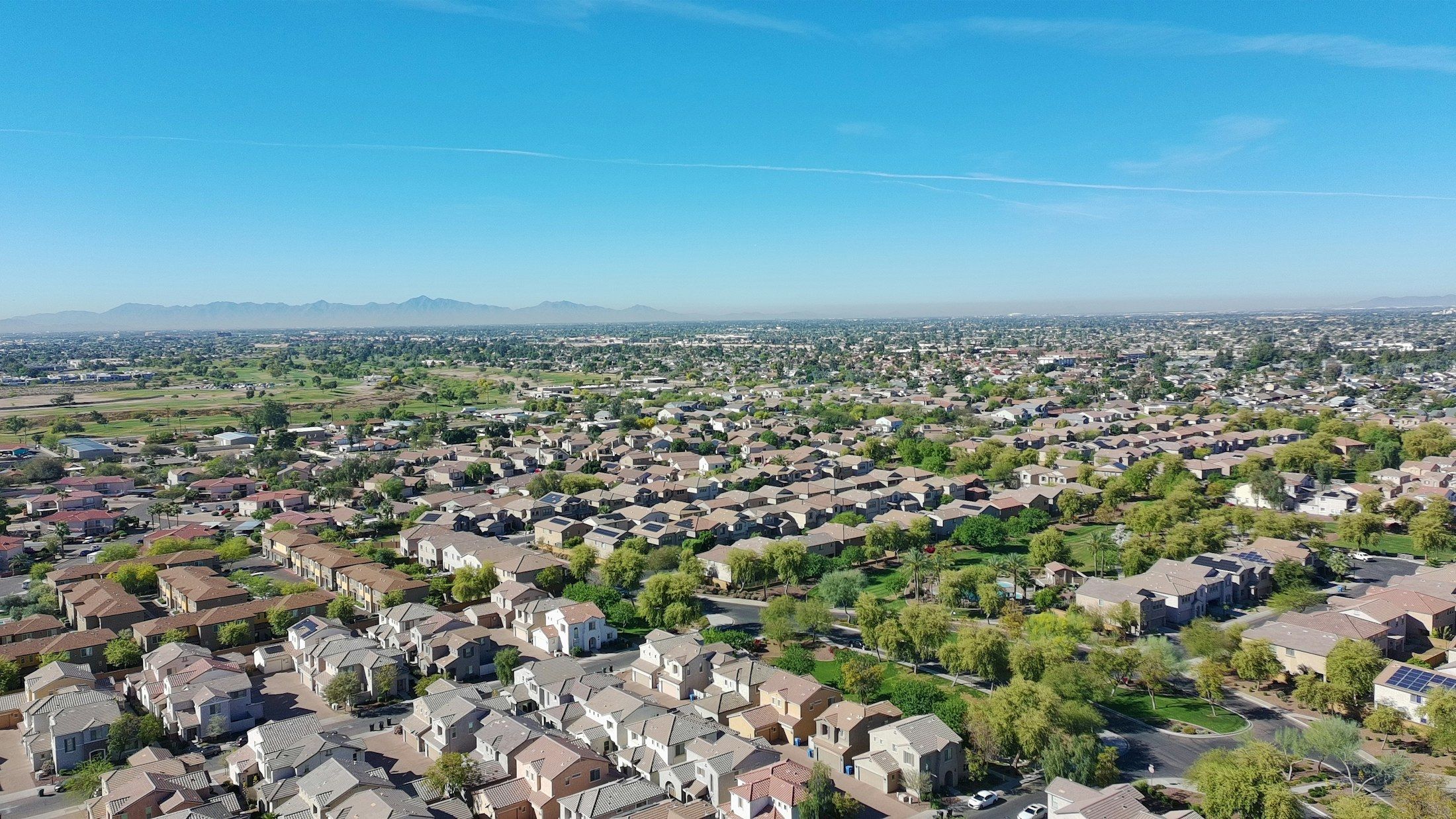
Ahwatukee is part of Phoenix
Ahwatukee Foothills is one of Phoenix’s 15 urban villages, and nearly all of it lies inside Phoenix city limits. It’s bounded by I-10 on the east, South Mountain Park on the north and the Gila River Indian Community on the west and south. Tempe and Chandler sit across the freeway, but Ahwatukee belongs to neither.
Development started in the early 1970s as one of the first master-planned communities in Arizona, and Phoenix annexed the area in stages during the 1980s. The city’s village plan still defines the area by “the prevalence of quiet, master planned, single-family neighborhoods.”
Homes from the 1980s and 1990s
Census figures (American Community Survey, 2020–2024) for Ahwatukee’s three main ZIP codes:
- 85044: median home built in 1989. The 1980s are the largest decade, and about 16% of homes date from the 1970s.
- 85048: median home built in 1995, with just over half built in the 1990s.
- 85045: median home built in 1999. About 91% of homes are owner-occupied.
That puts the median home in these ZIP codes at 27 to 37 years old. A house that age has likely been through at least one water heater, and anything still original deserves a look. ENERGY STAR puts a storage water heater’s typical life at about 13 years. If your water comes from the City of Phoenix, its 2025 report lists hardness of 10 to 17.6 grains per gallon, and the city says hard water can cause scaling in pipes and water heaters. See water heater and appliance leaks.
Other sources to keep an eye on: supply lines under sinks and toilets, washing machine hoses and the AC condensate drain. The Department of Energy’s Building America program warns that clogged drain lines and overflowing pans from equipment in attics and closets “can go undetected long enough to cause severe water damage.” A ceiling stain can be the first sign. If a pipe gives out inside a wall, see burst pipe water damage.
HOA communities: what to check
Many Ahwatukee homes are in HOA communities. The city’s village plan lists HOA-governed master-planned communities including the Ahwatukee Board of Management, Mountain Park Ranch, Lakewood, The Foothills, Foothills Club West and Foothills Reserve. It also says a large portion of the village is made up of Planned Community Districts.
Rules differ from one association to the next, so read your own documents and talk to your HOA or its management company. Questions worth asking:
- Who maintains what. Your governing documents, often called CC&Rs, spell out which parts of the property are yours and which the association maintains. That matters when water comes from a shared wall, a roof over more than one home or a common area.
- What needs approval. Some associations require approval for exterior work. If repairs will change a roof, stucco, doors or windows, ask what the HOA needs before that part of the job starts.
- Contractor access. Ask whether your community has rules on contractor parking, access or work hours.
Don’t hold off on stopping the water or drying the inside while you wait for answers. Insurers generally expect you to protect your home from further damage, and the EPA advises drying water-damaged areas within 24 to 48 hours to prevent mold growth.
Washes, hail and monsoon storms
Ahwatukee’s northern edge follows the foothills of South Mountain Park, which the city describes as “steep mountain slopes, deep desert washes, and undulating desert plains.” A 2004 city profile notes numerous washes and trails across the village, and the Ahwatukee Board of Management says its area alone includes about 106 acres of greenbelt and desert channels. The National Weather Service warns that monsoon rain “can accumulate very quickly, resulting in flooded streets or washes.”
Hail is part of the picture too. On November 19, 2025, a supercell storm dropped quarter- to golf-ball-size hail through Ahwatukee and Tempe, according to the National Weather Service. Damage from a storm like that may not show until the next rain gets through. If the association maintains your roof, report storm damage to them in writing. See monsoon and storm water damage.
First moves after a leak
- Stop the water at the fixture or your main shut-off valve. The shut-off valve guide shows where to look.
- Photograph the water, the source and the damage.
- If a shared wall, shared roof or common area is involved, notify your HOA in writing.
- Call to reach an independent restoration provider that serves Ahwatukee, and a plumber or roofer for the repair.